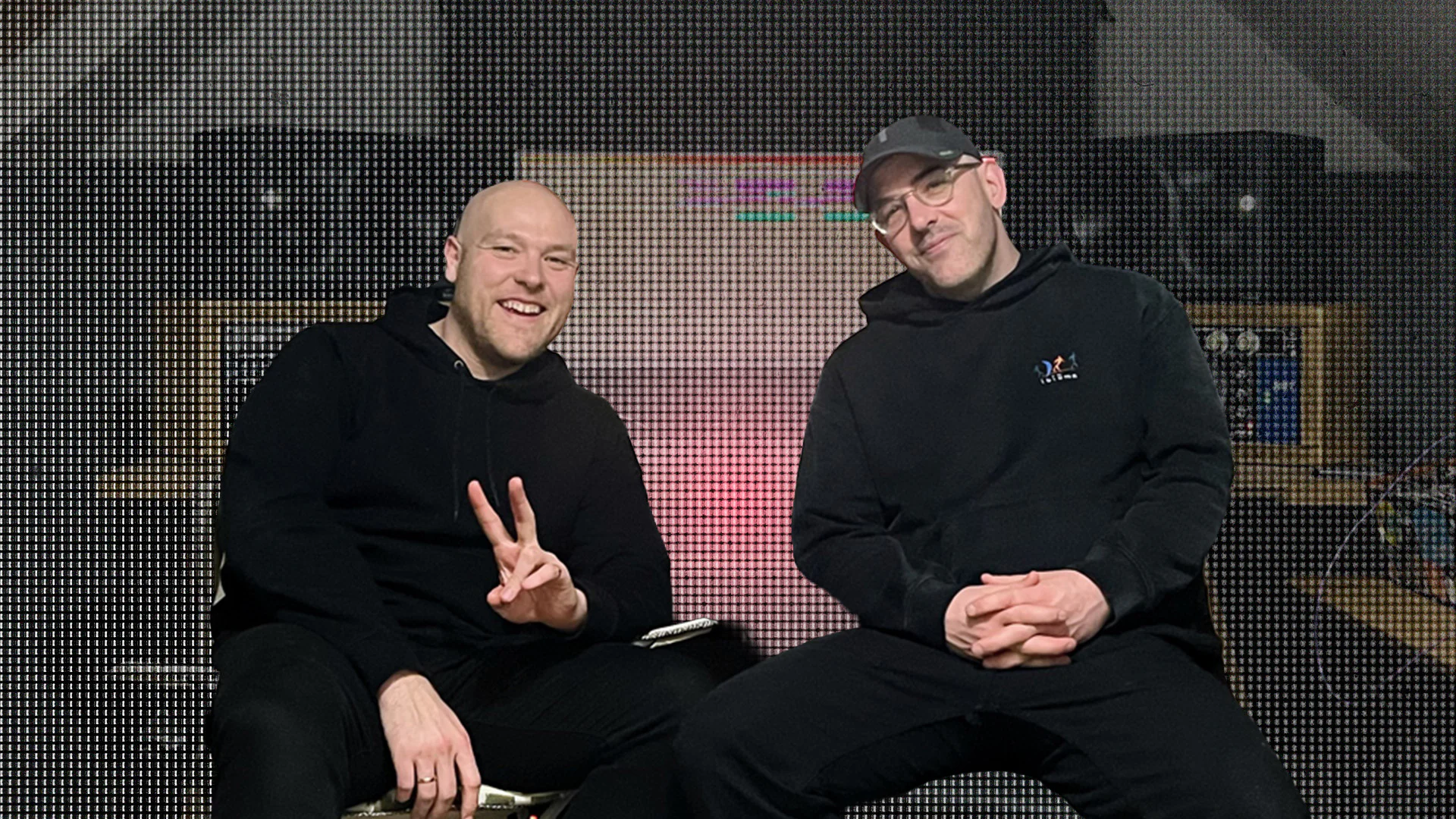
The UK-based Electronic duo discusses how their setup has evolved, how they make the most of both hardware and software, and why intuitive synths help them turn ideas into music faster.
For years, Mak & Pasteman built their creative process around enviable hardware setups. Although they still own a choice collection of analogue gear, they now spend most of their time working in the box.
We recently spoke to Mak (Craig) and Pasteman (Matt) about prioritising efficiency over equipment, how software has enabled them to make more music from opposite ends of the country, and why GForce synths are a natural fit for their workflow.
Welcome to The Bobsled
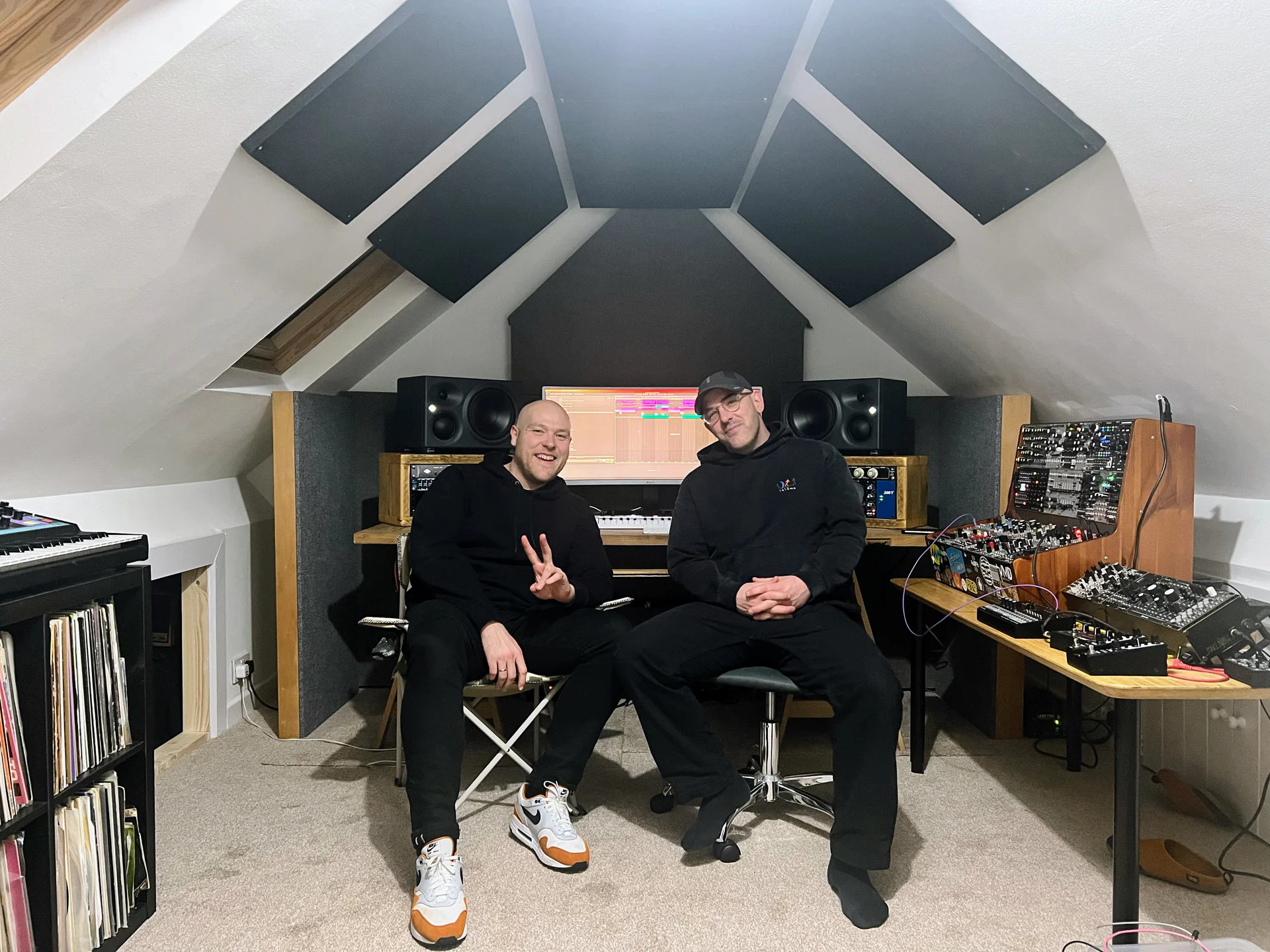
Matt and Craig join us from London and Leeds respectively, with the latter of the duo calling in from “The Bobsled” – a studio so-called because of its long but cosy dimensions. Craig shares a quick insight into their current hardware setup.
“I’ve got some 500 Series stuff, which I put all our drums through to add some colour and soften the digital top end. Then I’ve got the modular system and a few choice synths, including a Korg Arp Odyssey, a Moog Matriarch, and a rack of 90s synths and samplers.”
While it might sound like a sizeable collection, Craig explains that every piece of kit has a distinct purpose and has earned its place over years of refinement.
“There’s so much you can do with software now.”
“I’ve always been a gearhead, me. I love modular, I love synths, and I love software too. I went fully hardware at one point, but I’ve just kept what I use. I’d say we’re now 60 or 70 percent in-the-box. There’s so much you can do with software now.”
Choosing Efficiency Over Hardware
Over the years, the pair has refined their workflow to suit their needs, even if that means leaving the expensive new hardware synth switched off at times.
“Making random modular soundscapes is great, but for what we do, we need to be able to control what we’re doing to give the music some form. Software enables us to do that much more easily.”
//image: GF002_mak_and_pasteman_roland_808
For Matt, software makes it much easier to capture ideas as soon as inspiration strikes.
“For me, it’s more about how quickly I can execute what’s on my mind. I generate a lot of ideas, and while we used to work on hardware and in person, I’d say we finish about five times more music now.”
He also explains that whatever you use to make music, it’s important to know your equipment and its strengths, because that helps you make better decisions faster.
“If I want to make a pad, a lead, an arp, or whatever kind of sound, I know which tools are my go-to and how to get a really good sound out of something quickly.”
Why GForce Software Fits Their Workflow
Mak & Pasteman own a handful of GForce Software synths, and although each serves a different purpose, they all help the pair to convert ideas into music with minimal friction. Matt talks us through their experience with Halogen and FM synthesis in general.
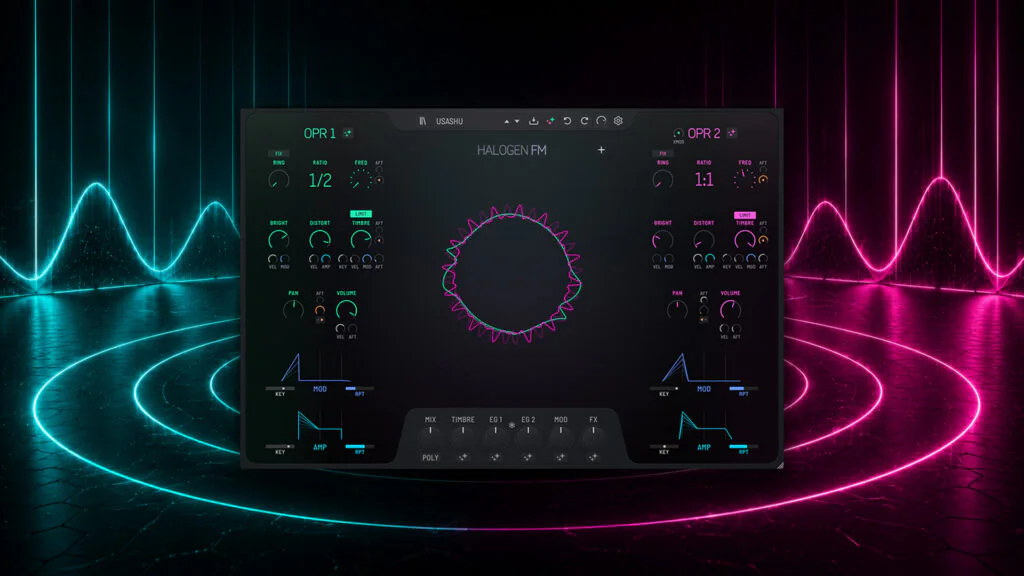
“We’ve always loved FM synths because of their unique character, and have even owned quite a few classics, but they’re just not very flexible in hardware form. We bought Halogen as it offered those interesting digital sounds in a much more flexible environment, and we were really impressed with it.”
//embed: Introducing Halogen FM
Halogen has since become a regular part of their productions.
“The synth’s architecture gives you lots of modulation options, and we’ve used it for all sorts of different sounds, including FX, lead sounds, pads, and additional layers.”
As for Craig, he’s been using Oberheim TVS Pro a lot, and not just because of its rich sound.
“I really like the flexibility of the sequencer and envelopes. I’ve been inputting notes, triggering the sequencer by key, and assigning the velocity to different parameters. It’s really nice for creating plucky synth lines or fat growling basses.”
They’ve found that every GForce plugin they’ve tried has an intuitive interface, and as Craig explains, this is incredibly important to their workflow.
“The GForce plugins are intuitive, and that works for us.”
“I can’t deal with synths that I have to spend ages figuring out; we just don’t have time to do that. If it’s hard to get on with, I don’t use it. The GForce plugins are intuitive, and that works for us.”
That ease of use extends to the Oberheim SEM, which has become a popular fixture in Mak & Pasteman’s arsenal. Matt echoes Craig’s comments about the importance of simplicity, and highlights why the SEM has become a firm favourite.
“Not only is it so simple to use, but the analogue emulation and the feeling it creates sound really authentic. With a bit of processing, you’d be hard-pressed to tell the difference between it and an actual Oberheim SEM.”
Each plugin has its place sonically, but they all help Mak & Pasteman to convert ideas into music with minimal friction.
Trusting Instinct Over Conventions
For some artists, sound design is a formulaic process, with individual sessions dedicated to creating sounds and synth patches. For Mak & Pasteman, sound design is more about identifying what the song needs and going from there.
“We don’t really have any go-to sound design techniques that we always use, but we have an arsenal of skills and approaches to choose from. Some are quite intuitive, some are more unorthodox.”
//embed: Mak & Pasteman – Le Freak
Matt adds that you often pick up those unorthodox techniques when working with other artists. One such example stems from a session with Redlight, whose record label, Lobster Boy, has previously welcomed Mak & Pasteman.
“He put 10 transient designers on a snare, each with really minimal settings. For some reason, it made the snare absolutely snap. It doesn’t really make sense, but a lot of the time it’s about not making sense.”
Layering and Processing for Impact
Mak & Pasteman’s recent release, Pressure Point Volume 2, is littered with dynamic, gritty basses that take the project’s centre stage. Craig shares how they layered and distorted several elements to achieve a polished, club-ready sound in their track Bust It.
“I made the lead bass on the Korg Monologue, but it didn’t sound super-powerful. I layered it with another bass sound, and sent it to a parallel distortion chain with Ableton Live’s Roar device. Even though it’s from a hardware synth, it needed a lot of processing to get it to sound so menacing.”
This reinforces their realisation that analogue hardware is not the be-all and end-all, and that understanding how to apply the tools you have matters more than the tools themselves.
Working Collaboratively
You might assume that living almost 200 miles apart would make working together difficult, but as Matt and Craig already explained, working with software and streamlining their setups has made collaboration more efficient than ever. They also credit a greater understanding of their roles as another reason for their improved work rate, with Matt generating more ideas and Craig taking those ideas through to completion.
“Historically, our roles weren’t as clearly defined, and we weren’t really playing to our strengths. Craig is so far beyond me in terms of technical expertise, and rather than try to keep up with him, I’m happier generating ideas.”
Craig explains how that dynamic plays out in practice.
“If Matt gives me an idea with a breakdown and a drop, I can pretty much have the track finished in two or three hours. So he’ll come up with 15 or 20 ideas; a handful will be really good and become fully formed tracks. Whereas if I’m trying to generate ideas, I want to tweak everything, and I’ll faff for days.”
Matt also cites their age as a factor in their newfound sense of productivity.
“I think what comes with age is humility and a bit of a reduction in ego. We probably used to hold onto ideas a bit too long, but now we’re not precious about anything. If it’s s**t, it’s s**t, get rid of it!”
Upcoming Releases and Final Thoughts
//embed: Drifting
With a boatload of forthcoming releases across some of underground Electronic music’s most revered record labels, it’s clear their refined creative workflow is paying dividends. Matt shares what we can expect from them over the coming months.
“We’ve got releases coming on Shall Not Fade and DEXT, one of which is our first vinyl release as Echosystem, another project we’ve started with our close friend Matt Burke. We’ve also just had our masters back for our next Mak & Pasteman release, which we can’t reveal just yet.”
“It’s easier than ever to make professional music on a laptop.”
“Other than that, we’re always working on music and sharing ideas. It’s an incredible time to make music; software has democratised it and made it so accessible. Now, it’s easier than ever to make professional music on a laptop.”
Thanks to Matt and Craig for speaking with us. You can follow them and their upcoming releases via their Instagram and Bandcamp pages.