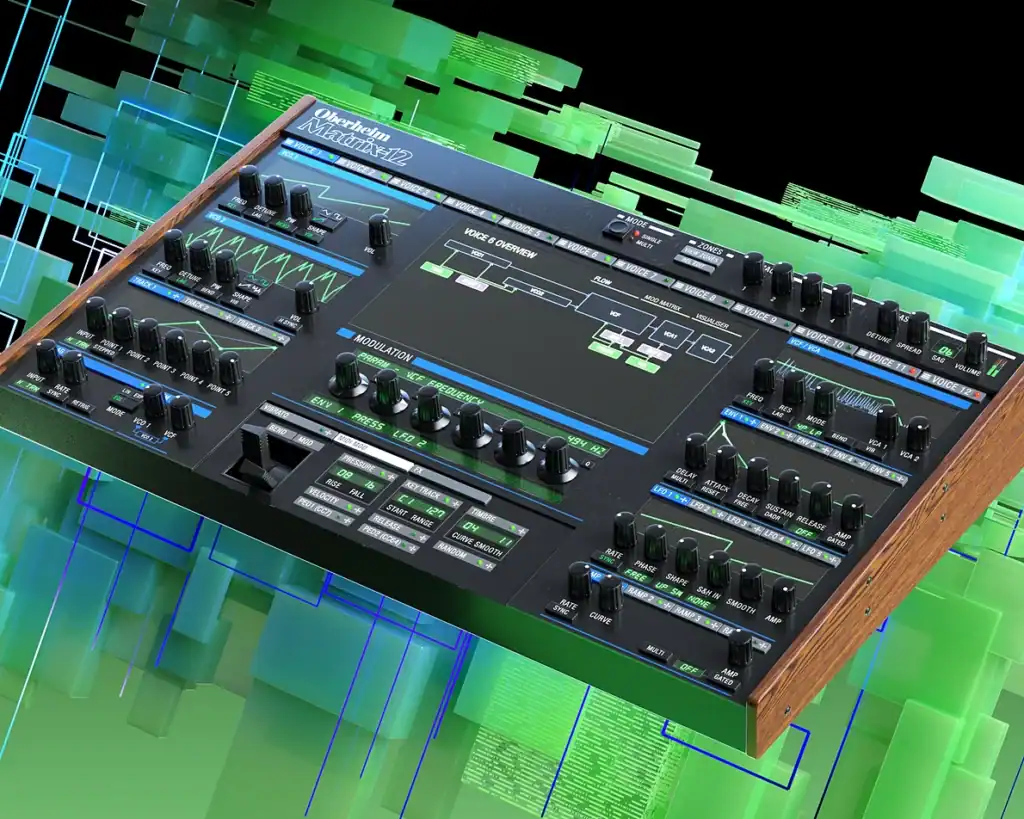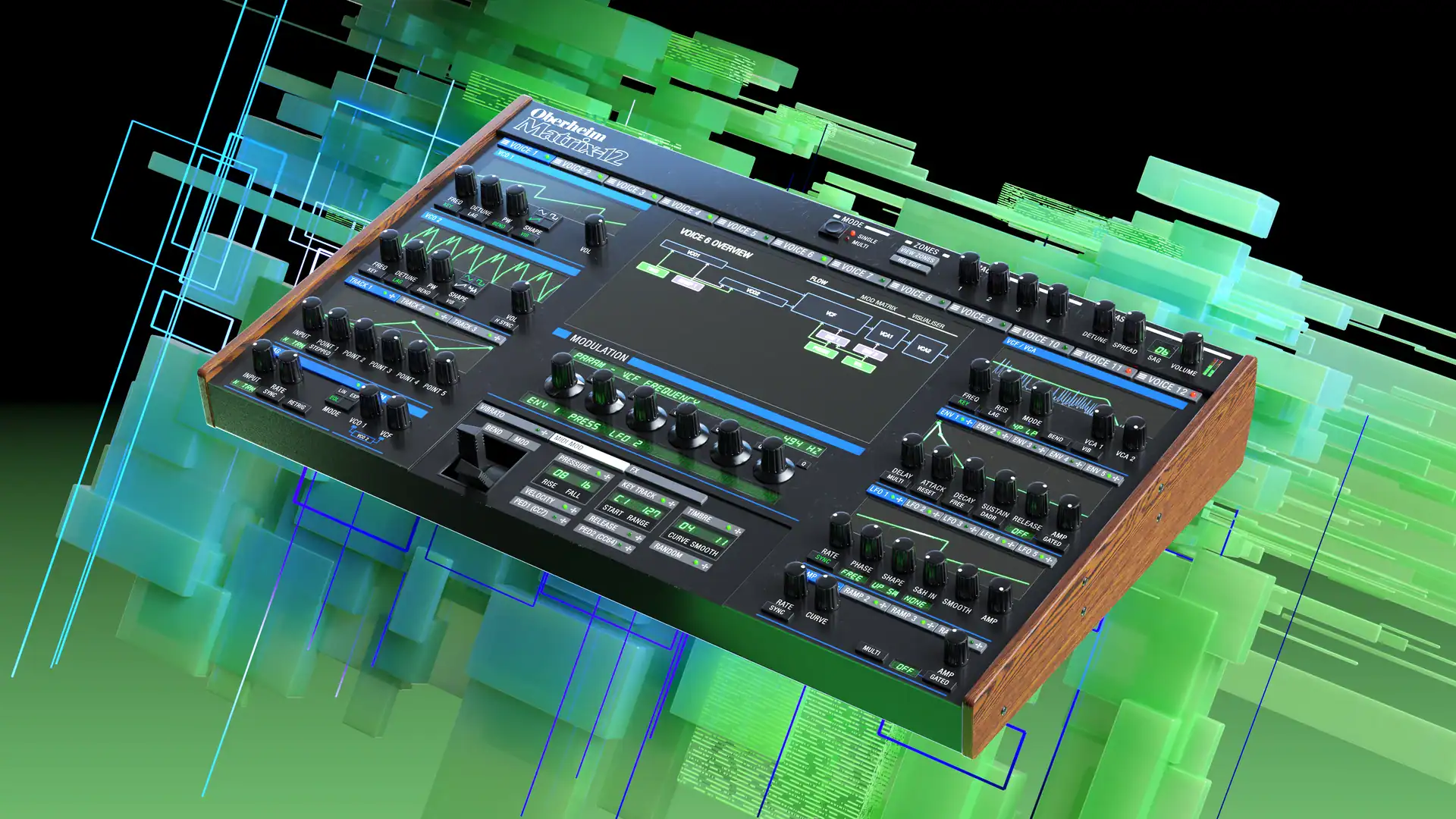
LONDON, 5 NOVEMBER 2026. GForce Software today releases Oberheim Matrix-12 for macOS and Windows, the only official software instrument of the Oberheim Matrix-12 and Xpander. Created in collaboration with Oberheim and Marcus Ryle, one of the Matrix-12’s original designers, it recreates Oberheim’s most ambitious analogue synthesiser. It rebuilds its legendary modulation system around a modern, visual interface.
Launched in 1985, the Matrix-12 sat at the summit of the classic Oberheim line. Twelve voices, a fifteen-mode filter, and Matrix Modulation, a virtual patching system so deep that Oberheim printed the routing map on the front panel because no screen of the time could show it. Vangelis, Depeche Mode, The Orb and Technotronic all reached for it, and it earned a reputation for the thickest analogue pads, sweeps, basses and textures ever recorded. Originals are rare, heavy and costly to keep alive, so for most players the sound has stayed out of reach.
The Real Oberheim Sound
Each voice has two modelled VCOs with triangle, saw, and pulse waves; the second adds noise and hard sync, feeding a filter with fifteen modes, one- to four-pole low pass, high pass, band pass, notch, phase, and the classic combinations, followed by two VCAs in series. GForce modelled the oscillators, filter and envelope shapes against the hardware, with one goal: sound like a Matrix-12.
The Matrix, Made Visible
Every voice carries five envelopes, five LFOs, four ramps, three trackers, and a lag processor, plus a dedicated vibrato, keyboard, velocity, release velocity, pressure, pitch bend, mod wheel, random, and full MPE. Any source can reach any destination, including itself. Players drag a crosshair from a source and drop it on a knob, with six bipolar modulation slots per parameter, each with quantise, and a green corona showing exactly where the sound will go.
Three views explain every voice at a glance. Flow draws a live diagram of the signal path and every modulation source as it is connected. The Mod Matrix lays out every connection in a grid you can sort, filter, and edit. The Visualiser shows the sound itself, and each module has its own scope, filter curve, envelope shape, or tracker graph that you can drag directly.
Twelve Voices, Six Zones
Single mode plays all twelve voices as one instrument with polyphony, unison, detune and spread. Multi mode turns every voice into its own timbre, with six keyboard zones that can overlap, each with its own voice allocation, MIDI channel and micro arpeggiator. Voices can be soloed, copied, locked or loaded on their own from any patch, and Relative Edit moves a whole zone at once.
Enhanced Where It Counts
GForce focused on the programming experience. The Matrix-12 is still a monster of a synthesiser, with modulation possibilities that can feel awe-inspiring, and assigning multiple modulations on the original hardware required navigating its complexity; now it’s fast and intuitive. The result is a legendary instrument that’s far more accessible to sound designers, without sacrificing any of its depth or complexity.
GForce rebuilt the Matrix-12 workflow with drag-and-drop modulation, the Flow diagram, the Mod Matrix, and a visualiser on every module, bringing the entire modulation system into view, while per-voice load, copy and lock, Relative Edit, and a fully resizable interface make editing twelve voices fast and direct.
New sound features include six micro arpeggiators, one for each keyboard zone; tempo-synced ramps with linear-to-exponential curves; smoothing on every LFO shape; and a stepped tracker mode that turns any LFO into a four-step sequence. Full MPE, four global Macros and studio-quality stereo delay and matrix reverb, with per-voice sends in Multi mode, complete the instrument.
Matrix-12 ships with over 570 patches: more than 380 new patches and more than 190 original Matrix-12 and Xpander patches.
“The Matrix-12 is the deepest instrument Oberheim ever built, but on the hardware, most of that depth was hidden behind a small display. Working with Oberheim and Marcus Ryle, one of the original designers, we set out to keep every detail of that sound and finally put the whole matrix in front of the player, where you can see it, touch it and play it.” Dave Spiers and Chris Macleod, co-founders of GForce Software.
Oberheim Matrix-12: Key Features
- The only official Oberheim Matrix-12 and Xpander software instrument, developed with Marcus Ryle
- Twelve voices, two modelled VCOs each with hard sync and FM, a fifteen-mode filter and dual VCAs
- Five envelopes, five LFOs, four ramps, three trackers and lag per voice, plus a global vibrato, any source to any destination
- Drag-and-drop modulation with six bipolar slots per parameter, quantise, and live coronas.
- Flow diagram: a live map of every voice, drawn as you patch
- Mod Matrix: every connection in one grid you can sort, filter and edit
- Visualiser, plus a scope, filter curve or envelope display on every module
- Single and Multi modes, six overlapping keyboard zones with micro arpeggiators, per-voice load, copy, lock and Relative Edit
- Full MPE, velocity, release velocity, pressure with rise and fall, and four global Macros
- Stereo delay and matrix reverb, over 570 patches, a powerful browser and a fully resizable interface