July 29, 2026
by GForce Software
The Bristol-based music producer discusses the importance of the songwriting process, creating emotion through synthesis, and why expression comes before raw sound.
For many music producers, chasing a specific sound can be a never-ending quest. After nearly a decade producing all manner of Electronic music, Transistor Rhythms has discovered what actually matters most to his productions – expression and flexibility. Using an aging MIDI keyboard and several GForce Software plugins, he can quickly convert inspiration into powerful and emotive musical ideas.
While the Bristol-based producer’s roots are in Techno, over the past few years, he’s embraced the more melodic side of Electronic music, placing more emphasis on the songwriting process. In this interview, we speak with Transistor Rhythms about the creative influences behind his evolving sound, why song arrangement takes precedence above all else, and why a MIDI keyboard is the core of his setup.
Finding Musical Inspiration
For Transistor Rhythms, inspiration comes less from chasing novelty than from paying close attention to sounds, artists and production choices that already feel proven. His reference points move between the understated power of contemporary electronic music and the practical value of sounds that work reliably in a mix.
“I’d say I find new inspiration almost every day. I’m a long-time Daniel Avery fan. His productions are slick and understated, but still so powerful. Bicep is another inspiration of mine – I absolutely love what they’re doing at the moment.”
“I recently remixed their track UMBER, which was featured on BBC Introducing.”
That balance between inspiration and practicality also shapes the way he thinks about sound design.
“I do find myself using the Reese bass a lot. It just works across the whole frequency spectrum and on any speaker system. It creates that bed of sound underneath everything else, and if the melody has a lot of interest and movement, you don’t want your bass doing too much.”
There’s nothing wrong with adopting a paired-down approach when it comes to sound design and Transistor Rhythms applies this philosophy to how he creates lead synth parts.
“I’m always looking for a feeling. As I’ve become a more experienced producer, I’ve found that I’m not really trying to sound-design the craziest sounds. Instead, I think the songwriting is where I’ll find most of the emotion in a track.”
When creating the lead sound for his track, Are We Dreaming, he paid particular attention to the glides between notes.
“It’s just a single saw wave with some distortion. A lot of the sound comes from playing with the amp envelopes to create a push-and-pull effect. As for the portamento, it doesn’t sound right if you apply it to every note, so it’s about creating that glide between the right notes to create this beautiful bendy sound.”
Using GForce Software Instruments
Synth presets can be an effective way of finding inspiration. Transistor Rhythms finds that plugins with professionally crafted presets, such as our own, invite you to explore a range of new sounds.
“The GForce Software TVS Pro and Oddity3 both sound great – there are so many immediately usable presets. I’m not sure what the developers have done under the hood, but they sound amazing straight off the bat.”
“As with all the GForce plugins I’ve used, you don’t have to mess around for ages or apply much processing to get it to sound good.”
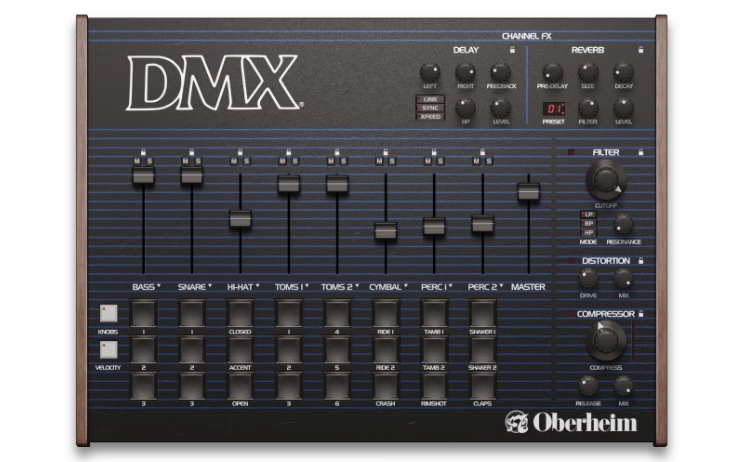
“I’ve also been using the DMX drum plugin. Again, it sounds fantastic, like you’re playing with an actual Oberheim DMX. As with all the GForce plugins I’ve used, you don’t have to mess around for ages or apply much processing to get it to sound good.”
“You can get a track started with just the kick and snare from the DMX, along with the built-in compressor and distortion. It just sounds massive.”
Similarly, GForce Software plugins’ built-in effects have enabled him to spend less time applying processing and more time making music.
“The built-in effects give you plenty of scope to enhance and color the sound, and then you can just move on with writing your track rather than getting caught up in loads of extra processing. You can get a track started with just the kick and snare from the DMX, along with the built-in compressor and distortion. It just sounds massive.”
Analogue Hardware vs Software and a MIDI Keyboard
Do the traditional merits of analogue hardware still stand? Transistor Rhythms suspects today’s soft synths paired with a MIDI keyboard can achieve the same thing.
“I use a Moog Model D clone a lot. It sounds great, is really playable, and the portamento works so well on it. I also had a Hydrasynth for a while, which was all over my last album, The Art of Being Yourself, which was great for going really deep into sound design.”
“Soft synths are so good these days, you don’t really need hardware for the sound.”
“To be completely honest, the best piece of hardware I own is a MIDI keyboard, which was the first thing I bought when I got into production. It still works, and because soft synths are so good these days, you don’t really need hardware for the sound. For me, it’s about playability and expression, and a MIDI controller with some good soft synths gives me that.”
Songwriting and Arrangement Process
Transistor Rhythms revisits the making of his 2024 track and how some simpleMIDI effects helped him to write the melody.
“In Are We Dreaming, I wrote the chords and then used an arpeggiator in random mode, but modulated some of the parameters of the arpeggiator to create several iterations of the melody. Then I selected the bits that worked and did some fine-tuning with the timing, velocity, and portamento. It was more of a collaboration between me and an arpeggiator – I never could have played it that way manually!”
A common critique of Electronic music is that it can sound too robotic, but introducing some expression can help to bring a track to life.
“I usually arrange a track out to the point where I’m confident that it works musically, then I’ll use the controls on my MIDI keyboard to record live automation for multiple elements one after the other. I find recording the automation for the entire track gives it more cohesion and a more natural flow.
What Matters Most, The Music or The Mix?
For Transistor Rhythms, a solid mix comes long before the actual mixing stage, with careful attention to composition and arrangement.
“A song has to work from a musical standpoint first – you can’t mix your way out of a mess. You have to make sure you’ve arranged and prioritised your elements properly. It’s a skill you develop over time with experience and by making plenty of mistakes.”
“Getting the track right before you move onto the mix is crucial.”
“It’s surprising how far back you can push certain elements, particularly when you introduce a lot of saturation but turn their level right down. This helps to create a sense of depth, with some elements really up front and some tucked further behind. Finally, the spatial placement of each melodic element is really important. But yeah, getting the track right before you move onto the mix is crucial.”
Creating a Sense of Space and Familiarity
Reusing samples, synth patches, foley, and found sounds can enable Electronic music artists, like Transistor Rhythms, to develop a unique sound.
“If I find a good kick or hat sample, or I create a synth patch I like, I’ll keep it handy for use in future projects. I often use foley recordings and found sounds in my productions, too. I’ve been working on a track called Tregardock, which contains the audio from a video I took at a beach in Cornwall. You can hear God Gets You Back by Mogwai playing on a Bluetooth speaker in the background.
And can even be used as the foundation of a track.
“The recording sounded really atmospheric and musical. It had the sound of the environment as well as these musical elements, so I stretched it out to create this really textural drone sound. That became the bed of Tregardock, and all the other melodic elements revolve around that sound.”
Creative Collaboration
Working with other artists can help to revive old projects and take them in entirely new directions, as Transistor Rhythms discovered while working on a recent project.
“I got chatting with an artist from the Midlands called BEKIMACHINE. She had heard my previous album and suggested working together. I revisited a slightly older project, which was heavily inspired by the Techno I was hearing around 2015, and shared it with her.
“She sent it back with these really beautiful Trance-gated vocal pads, which took it away from this 4am roller and into something much more musical. Ahead of the release, we worked with a Berlin-based videographer called Tom Whitson to create a music video for the song. We’re really pleased with the release, which was premiered by Jaguar on BBC Radio One.”
What’s Next for Transistor Rhythms?
“Tregardock should be out in August of this year, and I’ve been working on a Jungle track called Nothing to Lose, which is uncharted territory for me. My friend Jon, who makes Techno as Edetto, helped with the mixdown for that one. While it works musically, it’s been really difficult to manage the level and energy throughout the arrangement. We had to get quite creative with the mix on that one!”
“I don’t believe Electronic music should be constrained to any one box.”
“I don’t believe Electronic music should be constrained to any one box, and this is reflected in my own production philosophy. My productions take something from every style of music I play, but there’s an emotive thread that runs through them all.”
Thanks to Transistor Rhythms for speaking with us. You can keep up with his forthcoming projects via his Instagram, YouTube and Spotify pages.
Featured Products
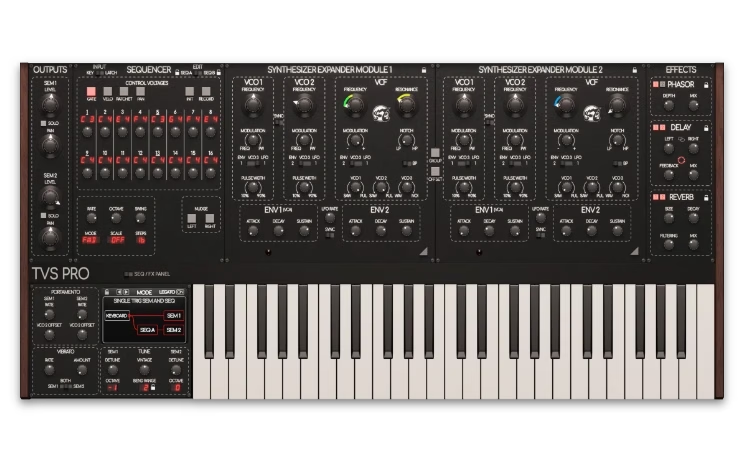
Oberheim TVS Pro
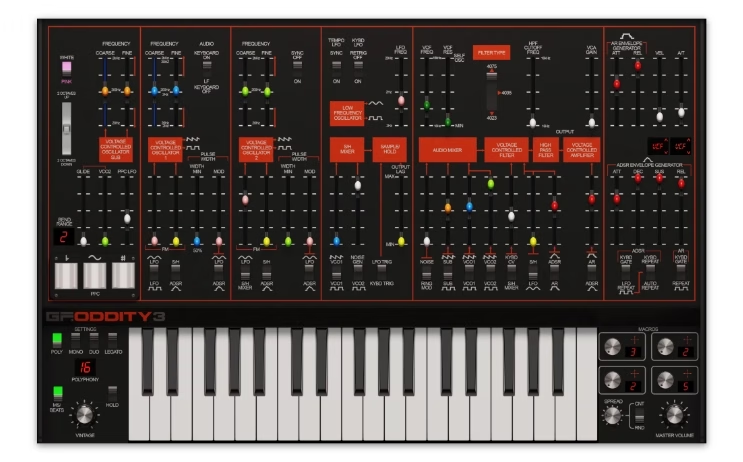
Oddity3